

Day after FUE surgery (front)
With FUE, your existing hair covers the donor area, so the surgery is hardly noticeable afterwards.


Undetectable even the next dayQuick return to daily life,natural-looking results
The next day, as if nothing happened
Non-Incision (Follicular Unit Extraction)
Undetectable even the next day — quick return to daily life,natural-looking results
Duration
About 8 hours
Anesthesia
Local · sedation
Recovery
Varies by person
Final result
About 1 year
 One year after FUE hair transplant at MOJELIM
About two weeks after surgery, the donor area at the back of the head has mostly healed — even lifting the hair reveals little sign of surgery.
Which surgical method is right for me?
FUT (Strip)
FUE (Non-incision)


A strip of scalp is taken from the back of the head, and healthy follicles are transplanted to the area that needs hair
Only the follicles needed are extracted one by one from between the hairs, without an incision
Well suited to large sessions
Minimal damage to the scalp
Relatively lower cost
Relatively less pain, faster recovery
Shorter surgery time
Hardly noticeable right after surgery
※ FUT and FUE differ only in how follicles are harvested — neither is overwhelmingly better. The right method is determined by diagnosis, based on your scalp condition and stage of hair loss.

A transplant no one notices
No shaving required —
return to daily life quickly

Naturalness, maximized
A gradation effect built
with fine hairs included

Optimal density
Fuller coverage through
multi-follicle selection

The secret to high survival
Two follicle technicians with
4+ years of experience each
Discreet harvesting for a quick return to daily life
Depending on the harvesting method, FUE can be performed without shaving, so you can keep your existing hairstyle through surgery.

A wide area of the lower back of the head is shaved before harvesting

Hair is taped up in rows 1–2mm apart before harvesting

Harvesting with no shaving at all — the most discreet cutting method
With FUE, your existing hair covers the donor area, so the surgery is hardly noticeable afterwards.

With FUE, your existing hair covers the donor area, so the surgery is hardly noticeable afterwards.

With FUE, your existing hair covers the donor area, so the surgery is hardly noticeable afterwards.

With FUE, your existing hair covers the donor area, so the surgery is hardly noticeable afterwards.

About two weeks after surgery, the donor area has mostly healed — even lifting the hair reveals little sign of surgery.
See our patients before and after surgery
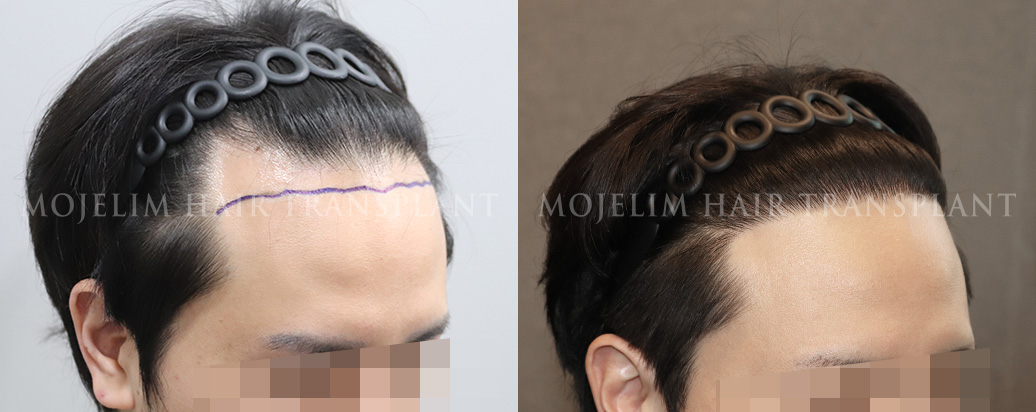 2023.04.152024.04.12
FUE hair transplant, 3,000 hairs
Day 363
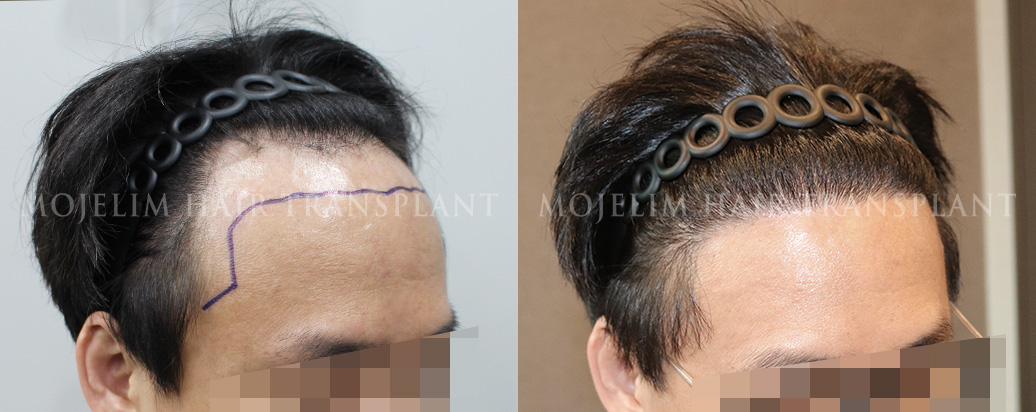 2023.06.162024.06.15
FUE hair transplant, 5,000 hairs
Day 365
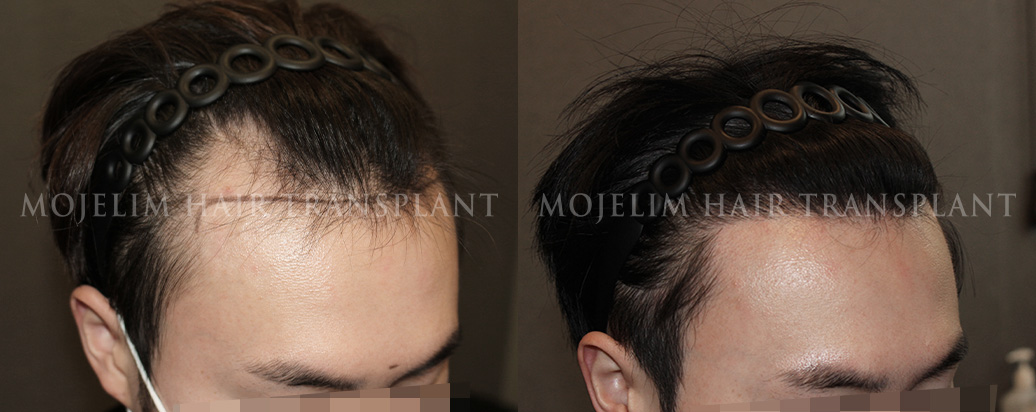 2022.12.202023.12.18
FUE hair transplant, 3,400 hairs
Day 363
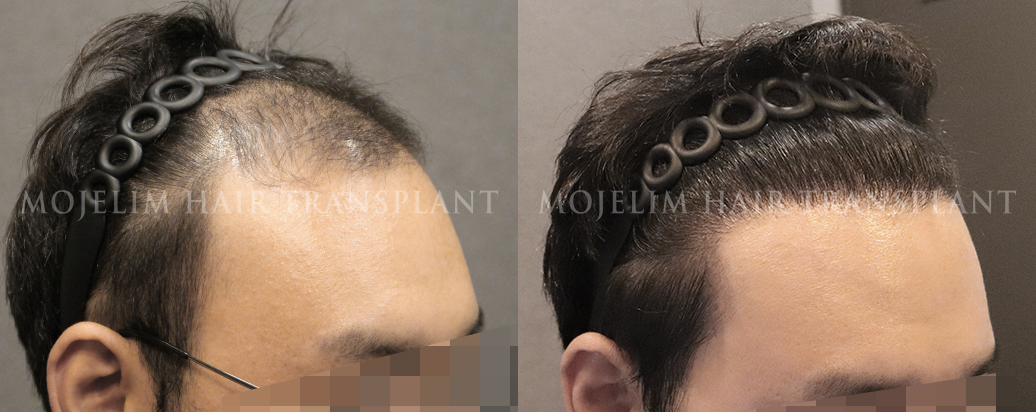 2024.06.272025.07.26
FUE hair transplant, 4,400 hairs
Day 394
※ The photos in this post were taken of the same patient under identical conditions, with the patient's consent, after surgery or treatment at MOJELIM Plastic Surgery Clinic.
※ Pain, bleeding, folliculitis and pigmentation may occur after surgery or treatment, and bruising, swelling and the results themselves vary from person to person.
※ Before-and-after photos show the result at the number of days elapsed stated and may differ from what you see in person.
Precision harvesting technique considered down to 0.01mm

Harvested too shallow
Root damage — lower survival rate

Harvested too wide
Tissue damage — scarring, slower recovery

Ideal harvesting
Optimal extraction — minimal scarring
With you for a full year, until every graft takes root

Shampoo


Progress check and follow-up call
Precision care for the first 72 hours

Survival spray
Epidermal growth factor helps
transplanted hairs survive and the
implant area recover quickly.

Ice pack
Reduces swelling
after surgery
* Keep it away from the implant area

Pillow cover
Prevents infection of the
surgical area through the pillow

Hydrogen peroxide
Disinfect once daily until stitches
are removed, against inflammation
* FUT only For the sutured donor area
From the day of surgery to one year
Preview how your scalp will change after surgery
Can I return to daily life the day after surgery?
Yes — both daily activities and shampooing are possible from the day after surgery.
How painful is the surgery?
Local anesthesia is administered after sedation, so there is very little pain during surgery itself, and any discomfort afterwards can be managed with painkillers.
When can I drink and smoke after surgery?
Alcohol and smoking are possible from day 10 after surgery, once the grafts have fully taken root.
Does FUE require shaving?
It depends on the harvesting method. The Two-Block Cut shaves a wide area of the lower back of the head; the Hide Cut tapes hair up in rows 1–2mm apart; and the No-Cut harvests without any shaving. Your existing hair covers the donor area, so the surgery is hardly noticeable afterwards.
How long does FUE surgery take?
About 8 hours, depending on the number of grafts. It is performed under local anesthesia with sedation.
Does FUE leave scars?
Follicles are extracted one by one with a punch, without an incision, so there is no linear scar as with the strip method, and damage to the scalp is minimized.
Which is better, FUT or FUE?
FUT and FUE differ only in how follicles are harvested — neither is overwhelmingly better. The right method is determined by diagnosis, based on your scalp condition and stage of hair loss.
Is there swelling after hairline correction?
There is hardly any swelling. During surgery, MOJELIM administers an anti-swelling injection to minimize it.
Why is crown (vertex) transplantation considered difficult?
Around the crown, hair grows in a radial, spiral pattern centered on the whorl, so directions are irregular — and blood flow is lower than in other areas, making graft survival more demanding. The direction, angle and depth of each hair are therefore finely controlled as grafts are placed between your existing hairs.
Can the crown be treated with FUE too?
The published crown cases were performed with FUE — follicles are placed between your existing hairs without damaging them, building up density. The method is decided in consultation, based on your scalp condition and stage of hair loss.
How many hairs does a crown transplant need?
Even with the same graft count, coverage and visual density depend on the placement strategy. Rather than a simple number, we plan the implant area, protection of existing hair, possible future hair loss, and donor follicle allocation together — the required count is explained after diagnosis, with its basis.
How is the cost of a crown transplant determined?
It is not 'X hairs for Y' — it depends on the implant area, the plan for protecting existing hair, allowance for future hair loss, and follow-up care. In your consultation, ask for the total cost along with the basis for the graft count, the implant area, the plan for protecting existing hair, and the follow-up check system.
Do I still need hair-loss medication after a crown transplant?
Crown hair loss is a progressive condition driven by the hormone DHT, so medication and scalp care should continue after the transplant to preserve both transplanted and existing hair long-term.
Should I transplant right away, or try medication first?
If follicle function remains in the early stage, medication and observation come first; if scalp exposure is clear, a transplant is considered alongside treatment. The treatment approach and surgical plan depend on how far the hair loss has progressed.
See the operating system MOJELIM has refined for excellent surgical results.
From consultation to surgery
Q
Does the surgeon ever change to someone else mid-surgery?
A
At MOJELIM, your surgeon personally operates from the start of surgery to the end.


One surgeon takes responsibility for your surgery from beginning to end.
Because one surgeon handles everything from consultation to surgery, results are more natural with higher graft survival.
Q
MOJELIM performs many surgeries — how do you manage your surgeons' condition?
A
Our surgeons follow a 'minimum surgery schedule,' entering every operation in peak condition.
FUT / FUE surgery
1–2 per day
Surgeries per MOJELIM surgeon, per day
A surgeon’s condition can affect the safety and results of that day’s patients.
To maintain personal condition and surgical skill,
each MOJELIM surgeon performs only one or two operations per day.
Q
Could a new doctor be operating on me?
A
Even new doctors complete a two-year training period before performing surgery.


At MOJELIM, a doctor may perform surgery only after at least two years of training.
(Two years of residency after obtaining a medical license)
During those two years, each doctor takes part in about 1,000 surgeries (roughly 4,000 hours).
This training system is how MOJELIM promises consistently satisfying results, whoever your surgeon is.
The right team size
Q
How many staff take part in a surgery?
A
Up to seven, for maximum surgical efficiency.


Surgical team
per patientSurgeon
1
Nurses
3
Follicle technicians
2–3
Per patient
1
patient in surgery
Up to
7
dedicated team members
In hair transplantation, the golden time between harvesting and implantation is a key factor in graft survival.
To shorten surgery time and raise efficiency, one surgeon, three nurses and two to three follicle technicians —
up to seven staff — work on a single patient’s surgery.

Extensive surgical experience
130,490 surgeries to date

A 2,200m² clinic
About 200 medical staff and team members

Separate men's & women's centers
Hair transplantation differentiated by gender
MOJELIM core strengths
Hair transplantation is a surgery where
a 0.1mm difference changes graft survival.
That is why your surgeon's experience
matters above all.
MOJELIM surgeons devote about 3,700 hours
a year to transplant surgery and research.
Hair transplantation is a surgical procedure where a 0.1mm
difference changes graft survival. That is why your surgeon's
experience matters above all.
MOJELIM surgeons devote about 3,700 hours a year —
eight hours a day — to hair transplant surgery and research.


